
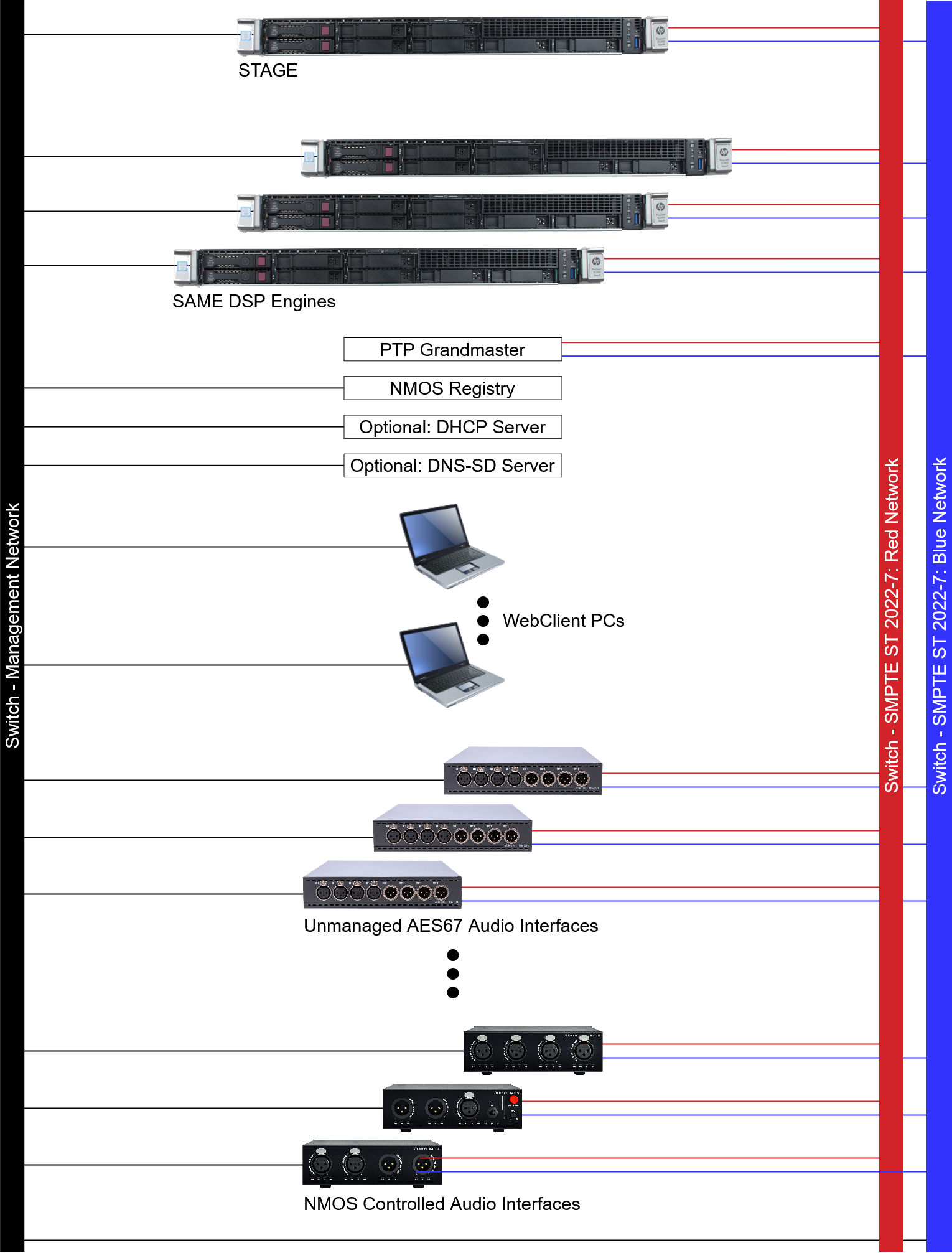
Here are the various building blocks required to create a STAGE / SAME DSP-Engine system and how they are interconnected. This network diagram will have to be adapted to your actual network architecture.
See also chapter Network Considerations.
Typical SAME DSP-Engine Network Architecture
A typical SAME DSP-Engine system is built using:
-
1 × STAGE hosted on a COTS server.
-
3 × SAME DSP Engines hosted on COTS servers.
-
2 × Network switches to create an SMPTE ST 2022-7 network. These switches are PTP enabled to ensure that audio is properly synchronized throughout the network.
-
1 × Network switch to create a management network. This is used for:
-
Device configuration and maintenance.
-
Operation and control.
-
-
PCs for configuration and system operation.
-
1 × NMOS Registry for device discovery and management.
-
NMOS audio interface devices as required to locally connect analog audio inputs and outputs to microphones, speakers, and external audio processors / legacy equipment.
-
Non-NMOS AES67 Audio Interface devices as required to locally connect analog audio inputs and outputs to microphones, speakers, and external audio processors / legacy equipment. In STAGE, these devices are called unmanaged hosts, as STAGE is unable to configure or control them.
Enabling network protocols such as DHCP, DNS-SD, and mDNS can greatly help with system setup and NMOS device discovery.
Typical SAME System