
NDI Core Integration
Production
Recommended for normal production use.
Caution
Compatibility Note: This information is a general guide and may be incomplete, may not match a specific project implementation, and is subject to change as supported products and versions evolve. Confirm the exact implementation and requirements for each project with Riedel and the relevant equipment vendor, then validate the required functions end to end in the target environment before deployment.
Minimum hi Version: v2.7.3
Overview
The NDI® Core Integration discovers NDI Sources and routes them to NDI receiver endpoints represented in hi. It uses configured NDI Discovery Server hosts when supplied; otherwise it uses local mDNS-SD discovery.
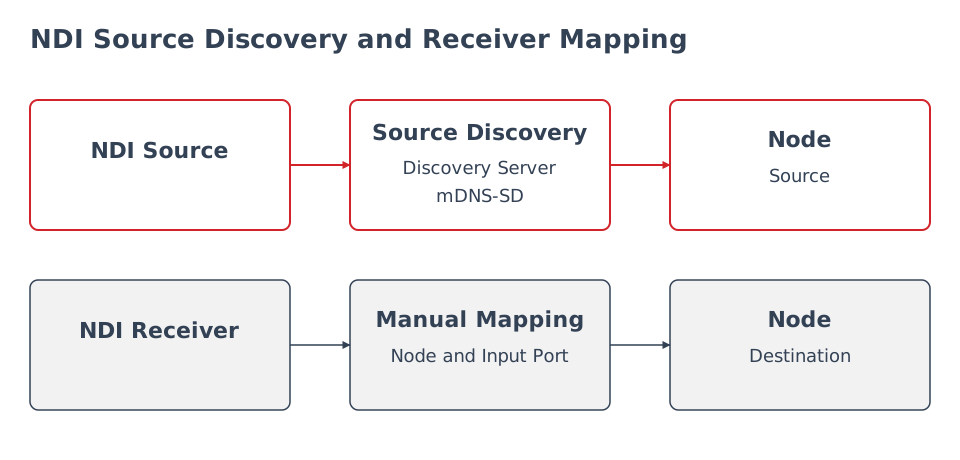
Source discovery supplies the Source representation in hi. Receiver Nodes and input Ports must be created and mapped manually using NDI Mappable Node. The diagram shows how these objects become available in hi; its arrows do not represent media transport.
Network Requirements
-
Connection Model: The integration uses the NDI SDK to discover Sources and control receiver routing.
-
Multicast / Unicast: Local discovery uses mDNS multicast. Discovery Server and Source sessions use unicast.
-
VLAN / IGMP: Follow the NDI network design for discovery and media traffic.
-
Bandwidth: Media bandwidth depends on the NDI formats used by the connected systems.
-
IP Version: Validate against the connected NDI products and Discovery Server deployment.
-
Firewall: Permit UDP 5353 for local mDNS discovery, TCP 5959 for an optional external Discovery Server, and the service-advertised TCP or UDP Source ports. Source ports are discovered by the SDK and can be higher when preferred ports are occupied.
Standards Conformance
|
Standard |
Conformance |
Notes |
|---|---|---|
|
NDI |
Implemented through the NDI SDK |
Vendor-defined protocol |
Operator Workflow
-
UI Surface in hi: Routing Matrix, Topology, and Inventory
-
Resources Controlled: NDI Sources, auto-discovered NDI Nodes, mappable receiver Nodes, and NDI input Ports
-
Routing Semantics: An NDI Source is assigned to a selected NDI receiver Port.
-
Additional Controls: Operators can create mappable NDI Nodes, add NDI input Ports, and select the default NDI Source used on disconnect.
Connection Methods
Connection: NDI SDK
|
Property |
Value |
|---|---|
|
Protocol |
NDI SDK |
|
Transport |
TCP and UDP |
|
Default Port |
TCP 5959 for Discovery Server
|
|
Authentication |
None
|
|
Encryption in Transit |
None
|
|
Connection Model |
SDK-based Source discovery and receiver routing |
|
Required License |
hiNDI |
|
Traffic Flow |
Bidirectional discovery and control
|
Connection: NDI Multicast DNS Service Discovery
|
Property |
Value |
|---|---|
|
Protocol |
NDI mDNS-SD discovery |
|
Transport |
UDP multicast |
|
Default Port |
5353 |
|
Authentication |
None |
|
Encryption in Transit |
None |
|
Connection Model |
Local multicast discovery when no Discovery Server is configured |
|
Required License |
hiNDI |
|
Traffic Flow |
Discovery queries and responses between hi and the local network |
Required Configuration
|
Parameter |
Description |
Default |
|---|---|---|
|
NDI Discovery Server Host |
One or more Discovery Server hosts
|
- |
|
Default NDI source |
Source assigned when an NDI Destination is disconnected |
None |
|
Reinitialize |
Reinitialize the NDI services |
- |
|
Reset |
Restart the NDI integration service |
- |
Device-Side Setup
Follow NDI Core Integration Configuration for the device-side and hi-side configuration steps.
Supported Features
|
Feature |
Access |
Exposed Operation and Scope |
|---|---|---|
|
Source and Node Discovery |
Read-only |
Discover NDI Sources locally or through a Discovery Server and represent discovered systems as hi Nodes. |
|
Receiver Routing |
Read/write |
Route a selected NDI Source to a supported NDI receiver Port. |
|
Mappable Nodes and Ports |
hi-side configuration |
Create operator-defined receiver Nodes and Ports in hi. |
|
Default Source |
hi-side configuration |
Select the Source used when a Destination is disconnected. |
|
Routed NDI Outputs |
Read/write |
Publish each receiver Port as a named NDI routed Source and change the NDI Source that it forwards. |
Device Coverage
Tested With identifies devices that have been tested with hi. Potentially Compatible (Not Yet Verified) identifies devices that use the same protocol or connection method but have not been tested with hi. Device-specific configuration, firmware, and feature support can affect results.
Tested With
-
BirdDog P200
-
Kiloview Multiview Player
-
NDI Tools
-
OBS Studio
Potentially Compatible (Not Yet Verified)
-
Panasonic PTZ cameras that send NDI.
-
Other NDI senders, receivers, software applications, and Discovery Server deployments that expose the functions used by this integration.
Known Limitations
-
Validate interoperability with the exact NDI product versions used by the installation.
-
Discovery and media reachability depend on the NDI network and Discovery Server configuration.
-
hi discovers NDI Sources and publishes its routed Sources in the default NDI group (
public). hi has no setting for NDI access groups.
What's Not Supported
-
Automatic discovery of NDI receiver products is not supported by the NDI version used in this hi integration. Source discovery remains supported; configure receiver Nodes and input Ports manually.
-
Vendor firmware updates or low-level NDI product configuration.
-
Media encoding-profile authoring from hi.
-
NDI PTZ control and NDI Tally. hi does not send PTZ commands or Tally states to NDI devices.
Trademarks
Note
NDI is a registered trademark of Vizrt NDI AB.
All product names, logos, and brands are property of their respective owners. Copyright in third-party software and materials remains with the respective owners. Use of these names does not imply endorsement.
RIEDEL Communications is not affiliated with, endorsed by, or officially partnered with Vizrt NDI AB unless explicitly stated.