
Layers
Overview
The hi system models signals on three Layers: Physical, Flow, and Essence. Each Layer describes a different part of the same signal relationship.
An audio signal from a microphone illustrates this layered structure. At the microphone itself the signal travels along a cable on its own, but it may later become a channel in a MADI stream. That MADI stream may in turn be transported with multiple other signals on a fiber link.
hi must be aware of all these relationships to calculate Tally and evaluate routing throughout the Topology. The hi system therefore relates Ports across three Layers.
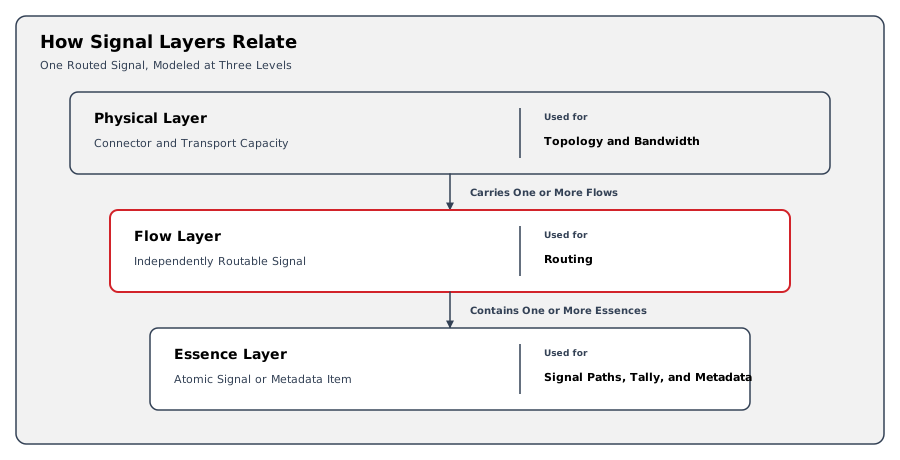
How the Layers Relate
Media signals can exist at multiple levels at the same time. For example, a physical connector can carry an SDI Flow that contains a video Essence and multiple audio Essences.
The three-Layer model allows hi to:
-
Model Tally at the Essence Layer - individual audio or video Essences can carry Tally information even when transported within a composite Flow.
-
Check routing compatibility at the Flow Layer - routing decisions can account for signal format and flow type.
-
Keep physical mapping separate - the Physical Layer represents connectors and transport capacity while operators typically route at the Flow Layer.
For a consolidated view of how Layers, Ports, Port Containers, Portals, and Signal Paths all work together, see Signal Routing Reference.
Physical Layer
A Port on the Physical Layer describes a physical input, output, or bidirectional connector of a device. A Physical Port can carry one or multiple Flows, for example:
-
an SDI output connector carrying one Flow with video and embedded audio Essences
-
an SFP interface carrying multiple SMPTE ST 2110 Flows
-
the physical NICs of an IP device
Information
The Physical Layer provides connectivity information used for potential Signal Path and available bandwidth calculations through the Topology.
Flow Layer
A Port on the Flow Layer describes a signal that can carry multiple Essences but can still be routed independently. For example:
-
an SDI video signal carrying a single video Essence, 16 audio Essences, and various metadata Essences
-
a SMPTE ST 2110-30 audio stream carrying one or more audio Essences ("channels")
-
a MADI stream carrying 64 audio Essences
Information
hi uses the Flow Layer for routing. Port Containers and Portals operate at this Layer.
Essence Layer
A Port on the Essence Layer is the most atomic signal representation in the system. It describes an indivisible signal item, for example:
-
one audio channel
-
one quadrant of a UHD quad-split stream
hi associates Tally and Metadata with Essence Ports. Their propagation still depends on the configured Signal Path and feature-specific rules.
Operational Implications
Use the Physical Layer to understand device connectivity, the Flow Layer for routing, and the Essence Layer for individual signal content.
These views describe related objects; a Flow can contain several Essences while sharing a Physical Port with other Flows.
The Signal Path Inspector presents its trace at the Essence Layer. A routing selection at the Flow Layer can therefore expose several underlying Essence relationships.
Related Tasks and Reference
-
Inspect a Signal Path - examine the calculated Essence Layer trace without changing routing.
-
View and Edit Topology - inspect the installation using the required Layer view.
-
Route a Source to a Destination - apply the Flow Layer routing model.
-
Signal Routing Reference - consult the relationships between Ports, containers, Portals, and Signal Paths.